When we talk about spiritual leaders who changed not just a nation but the entire world, one name rises above the rest — Swami Vivekananda. This Swami Vivekananda Biography takes you through the extraordinary journey of a young boy named Narendranath Datta who grew up to become one of the most influential spiritual figures in history.
Why does his story still matter today? Because he didn’t just preach religion — he ignited confidence, courage, and national pride. He stood at the crossroads of tradition and modernity and showed the world that India’s spiritual wisdom had universal value.
Let’s dive deep into the life, struggles, achievements, and legacy of this remarkable monk.
Early Life and Childhood
Swami Vivekananda was born as Narendranath Datta on January 12, 1863, in Kolkata. His father, Vishwanath Datta, was a successful lawyer with progressive views, while his mother, Bhuvaneshwari Devi, was deeply spiritual.
Imagine growing up in a household where intellectual debates and devotional songs both echoed through the halls. That was Narendra’s childhood — a blend of logic and faith.
From a very young age, he showed exceptional intelligence. He had a sharp memory and a questioning mind. Unlike other children, he didn’t accept things blindly. If someone told him about God, he wanted proof.
Education and Intellectual Development
Narendra studied at the Scottish Church College. There, he explored Western philosophy, history, literature, and science. He read thinkers like Kant and Herbert Spencer, which expanded his rational outlook.
But here’s the interesting part — despite being fascinated by Western thought, he felt something missing. Books gave him ideas, but not experience. He wasn’t satisfied with theory. He wanted realization.
Isn’t that relatable? Sometimes knowledge isn’t enough — we want truth.
Spiritual Crisis and the Search for God
As a young man, Narendra went through a spiritual crisis. He began asking religious leaders a bold question:
“Have you seen God?”
Most gave vague or philosophical answers. But Narendra wanted certainty — not poetry.
This search eventually led him to Ramakrishna Paramahamsa at the Dakshineswar temple.
Meeting with Ramakrishna Paramahamsa
When Narendra first met Ramakrishna, he was skeptical. The saint seemed simple, emotional, and unconventional. But something about him felt genuine.
When asked the famous question — “Have you seen God?” — Ramakrishna replied, “Yes, I see Him as clearly as I see you.”
That answer changed everything.
Under Ramakrishna’s guidance, Narendra experienced deep spiritual states. His doubts slowly dissolved. He realized that spirituality was not blind belief but direct experience.
This turning point is central to any detailed Swami Vivekananda Biography, because without Ramakrishna, there would be no Vivekananda.
Transformation into Swami Vivekananda
After Ramakrishna’s death in 1886, Narendra and other disciples formed a monastic brotherhood. Narendra took the name “Vivekananda,” which means “the bliss of discerning wisdom.”
He renounced worldly life and chose the path of a wandering monk.
But he wasn’t running away from society.
He was preparing to serve it.
Wandering Across India
Vivekananda traveled across India on foot. He visited palaces and huts, spoke with scholars and laborers. What he saw disturbed him deeply — poverty, illiteracy, social discrimination.
He realized that religion alone wasn’t enough. People needed education, strength, and dignity.
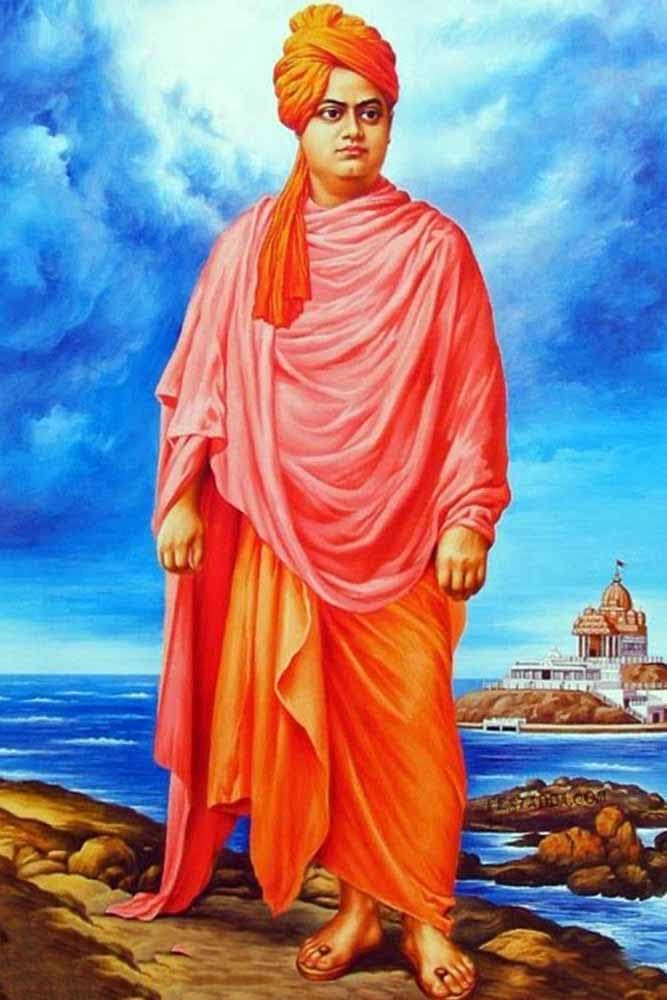
In 1892, he meditated on a rock in Kanyakumari. There, he envisioned a new India — strong, confident, and spiritually awakened.
Journey to the West
In 1893, Vivekananda traveled to the United States to attend the Parliament of the World’s Religions in Chicago.
The journey wasn’t easy. He faced financial struggles and uncertainty. But his determination was unshakeable.
Imagine traveling across the ocean with little money and immense faith. That’s courage.
The Historic Chicago Speech
On September 11, 1893, he addressed thousands with the opening words:
“Sisters and Brothers of America…”
The audience erupted into applause.
Why?
Because his words carried warmth, authenticity, and universal acceptance.
He spoke about tolerance, unity, and the idea that all religions lead to the same truth. The West was deeply impressed.
This moment remains one of the most powerful chapters in every Swami Vivekananda Biography.
Teachings and Philosophy
Vivekananda’s teachings were rooted in Vedanta but presented in practical terms.
He emphasized:
- Inner strength
- Self-confidence
- Service to humanity
- Universal brotherhood
He described four paths to spiritual growth:
- Karma Yoga – Path of action
- Bhakti Yoga – Path of devotion
- Raja Yoga – Path of meditation
- Jnana Yoga – Path of knowledge
Think of them as four different roads leading to the same mountain peak.
Establishment of Ramakrishna Mission
In 1897, he founded the Ramakrishna Mission.
Its motto: “Service to man is service to God.”
The Mission established schools, hospitals, libraries, and relief programs. For Vivekananda, spirituality meant action — not isolation.
Impact on Indian Nationalism
Although he was not directly involved in politics, his ideas ignited patriotism.
Leaders like Subhas Chandra Bose and Mahatma Gandhi drew inspiration from him.
He told Indian youth:
“You will be nearer to Heaven through football than through the study of the Gita.”
What did he mean?
Strength first. Weakness never.
Personal Qualities and Character
Vivekananda was fearless. He spoke boldly in foreign lands without hesitation.
Yet, he was compassionate and deeply empathetic toward the poor.
He combined the heart of a saint and the courage of a warrior.
Return to India
When he returned to India after his success in America, he received a hero’s welcome.
People saw him not just as a monk but as a symbol of national pride.
He urged Indians to rediscover their spiritual heritage and build a strong nation.
Final Years and Passing
Years of continuous travel and work took a toll on his health.
On July 4, 1902, at Belur Math near Kolkata, he passed away at just 39 years old.
Short life.
Eternal impact.
Legacy and Global Influence
The legacy of Swami Vivekananda continues today.
His birthday, January 12, is celebrated as National Youth Day in India.
His teachings influence leaders, thinkers, and spiritual seekers worldwide.
A complete Swami Vivekananda Biography shows us that he was more than a monk — he was a bridge between East and West.
Why Swami Vivekananda Still Matters Today
In a world divided by religion and identity, his message of universal acceptance feels more relevant than ever.
In a world battling self-doubt, his message of inner strength empowers millions.
He taught us that divinity is within.
Not outside.
Conclusion
This detailed Swami Vivekananda Biography reveals a life filled with courage, wisdom, and purpose. From a curious child in Kolkata to a global spiritual icon, his journey was nothing short of extraordinary.
He awakened India’s confidence at a time when it was deeply colonized and demoralized.
He showed the West that spirituality and rationality can coexist.
Most importantly, he reminded humanity of its own divine potential.
And perhaps that’s the greatest lesson of all — the power you seek is already within you.
FAQs
1. Who was Swami Vivekananda?
He was an Indian monk, philosopher, and spiritual leader who introduced Indian philosophy to the Western world.
2. Why is Swami Vivekananda famous?
He is famous for his speech at the 1893 Parliament of the World’s Religions in Chicago.
3. What are his main teachings?
His teachings focus on strength, self-confidence, service to humanity, and universal brotherhood.
4. When did Swami Vivekananda die?
He passed away on July 4, 1902, at the age of 39.
5. Why is his birthday celebrated as National Youth Day?
Because his life and teachings continue to inspire young people to build character, confidence, and courage.